A squint, medically known as strabismus, is a visual condition characterized by ocular misalignment. While one eye looks straight ahead at a designated focal point, the other eye deviates inwards, outwards, upwards, or downwards. This lack of visual coordination prevents both eyes from focusing on the same spot simultaneously, making proper binocular vision impossible and disrupting 3D depth perception.
Although strabismus is frequently diagnosed during early childhood, it can affect individuals at any stage of life. Modern ophthalmic care offers several effective corrective pathways to realign the eyes and preserve long-term visual function.
Primary Causes of Strabismus
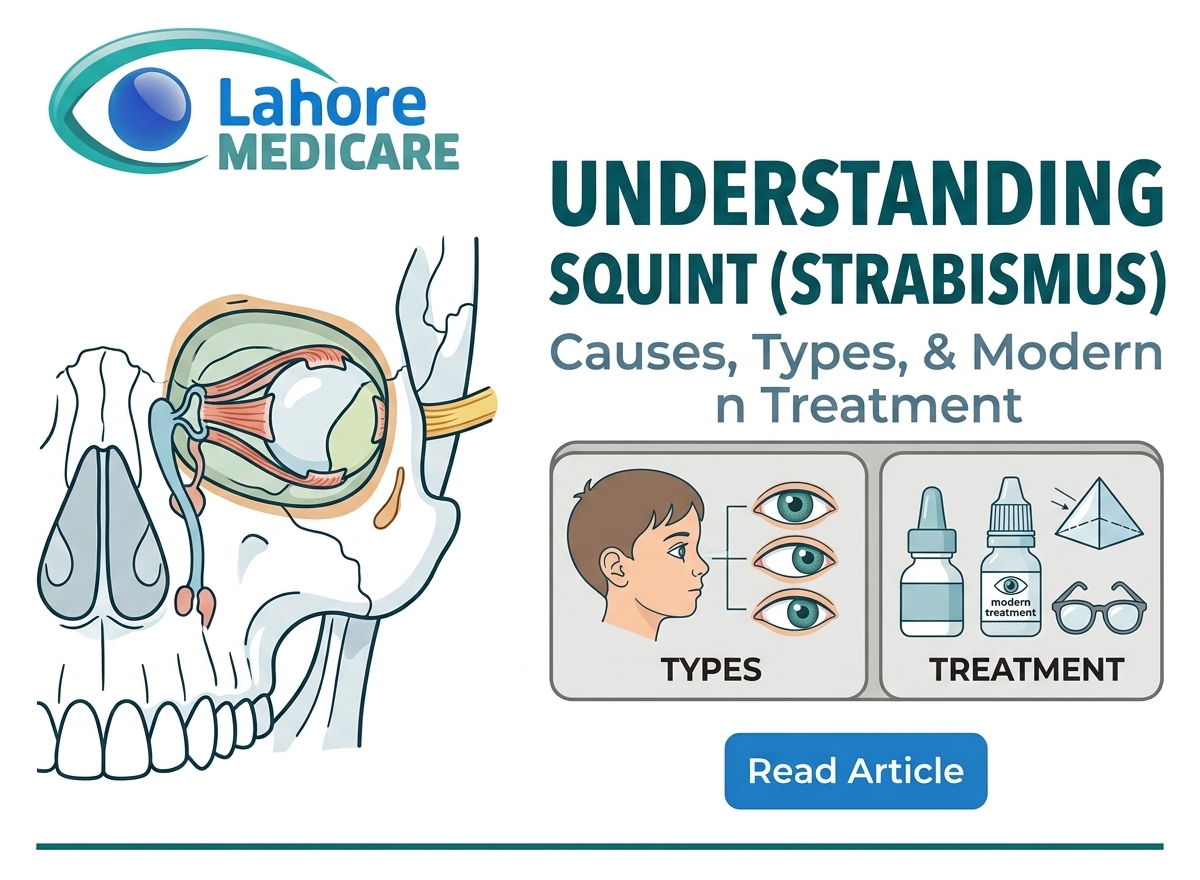
Proper eye alignment depends on the coordinated interaction between extraocular muscles and the neurological pathways controlling them. Six distinct extraocular muscles attached to each eyeball regulate movement and eyelid position.
Strabismus occurs when these mechanisms experience disruption:
- Extraocular Muscle Imbalance: Weakness, tightness, or mechanical friction in one or more extraocular muscles prevents smooth, synchronized movement across both eyes.
- Neurological Signal Disruption: Cranial nerve disorders or central nervous system conditions can impair the brain’s ability to coordinate physical eye movements correctly.
- Uncorrected Refractive Errors: Severe farsightedness (hyperopia) causes excessive focusing effort, which can force the eyes to turn inward to maintain clarity.
- Systemic and Acquired Health Factors: In adults, sudden-onset strabismus can stem from thyroid eye disease, head trauma, stroke, or vascular complications linked to systemic conditions.
Classifying Types of Strabismus
Specialists classify strabismus based on the directional movement of the drifting eye, as well as whether the turning happens constantly or intermittently:
- Esotropia: The misaligned eye turns inward toward the nose (commonly known as crossed eyes).
- Exotropia: The misaligned eye turns outward toward the temple (commonly known as wall-eyes).
- Hypertropia: The misaligned eye turns upward relative to the straight eye.
- Hypotropia: The misaligned eye turns downward relative to the straight eye.
Strabismus can also be categorized by underlying mechanics, such as accommodative esotropia caused by focusing stress, or paralytic strabismus resulting from damaged cranial nerves.
Key Symptoms and Visual Impact
A squint causes more than just physical misalignment; it impacts how visual information is processed by the brain:
- Impaired Depth Perception: Without coordinated binocular vision, calculating distances and spatial depth becomes difficult.
- Double Vision (Diplopia): Adults acquiring strabismus often experience double images because the brain receives two misaligned visual signals.
- Amblyopia (Lazy Eye): In young children, the developing brain may ignore visual input from the drifting eye to avoid double vision, weakening visual acuity in that eye.
- Visual Strain and Headaches: Persistent muscle fatigue caused by attempting to align the eyes can trigger chronic eye discomfort.
A comprehensive examination at a specialized center like Lahore Medicare provides precise evaluation of muscle coordination and binocular vision status.
Modern Treatment Options for Strabismus
Effective treatment aims to restore eye alignment, optimize binocular vision, and prevent permanent acuity loss in amblyopic eyes.
Non-Surgical Interventions
For many patients, non-invasive therapies provide full or partial correction:
- Prescription Eyeglasses or Contact Lenses: Correcting uncorrected refractive errors relieves excessive accommodation efforts, allowing the eyes to realign naturally.
- Prism Lenses: Custom optical prisms bend light before it enters the eye, redirecting images onto the retina to eliminate diplopia.
- Occlusion (Patching) Therapy: Covering the stronger eye forces the brain to rely on the misaligned eye, treating amblyopia in children.
- Orthoptic Vision Therapy: Tailored eye exercises strengthen neuromuscular control, focusing coordination, and tracking capability.
Surgical Realignment Procedures
When non-surgical management cannot achieve adequate physical alignment, surgical correction is recommended. Strabismus surgery modifies the positioning or tension of the extraocular muscles. Surgeons can weaken an overactive muscle by moving its insertion point further back (recession) or strengthen an underactive muscle by shortening its length (resection).
Patients seeking evaluation for surgical or non-surgical alignment can explore specialized care through strabismus and squint correction surgery to restore proper alignment.
For complex cases linked to nerve palsies or progressive vascular issues, receiving targeted care for complex eye muscle conditions ensures long-term visual stability and alignment.
Frequently Asked Questions
What is the main difference between strabismus and amblyopia?
Strabismus is a physical misalignment of the extraocular muscles, whereas amblyopia (lazy eye) is a visual acuity deficit that occurs when the brain suppresses signals from one eye.
Can strabismus develop suddenly in adults?
Yes. Adult-onset strabismus can occur suddenly due to cranial nerve palsies, head trauma, stroke, thyroid disease, or uncontrolled diabetes.
What is the difference between esotropia and hypertropia?
Esotropia occurs when an eye turns inward toward the nose, while hypertropia occurs when an eye turns upward above the focal line of the straight eye.
Is squint correction possible without surgery?
Yes. Accommodative squints and mild misalignments can often be corrected using prescription refractive lenses, prism glasses, or visual therapy exercises.
How does strabismus affect depth perception?
Depth perception requires binocular vision, where both eyes view an object simultaneously from slightly different angles. Strabismus prevents simultaneous binocular alignment, impairing 3D spatial judgment.
At what age should a child with a squint be evaluated?
Children should be evaluated as early as possible. Prompt assessment prevents permanent visual loss from amblyopia and helps restore binocular vision during critical developmental stages.
What causes intermittent strabismus?
Intermittent strabismus happens when muscle coordination breaks down during periods of fatigue, illness, stress, or when focusing on distant or very close objects.
Does squint surgery require hospital stay?
No. Strabismus surgery is typically an outpatient procedure performed under local or general anesthesia, allowing patients to return home the same day.
Can squint surgery be performed on adults?
Yes. Strabismus surgery can be performed at any age to restore eye alignment, eliminate double vision, and improve visual cosmetics.
What happens during muscle recession and resection?
During recession, an extraocular muscle is detached and reattached further back on the eye to weaken its pull. During resection, a segment of the muscle is removed to shorten and strengthen its pull.