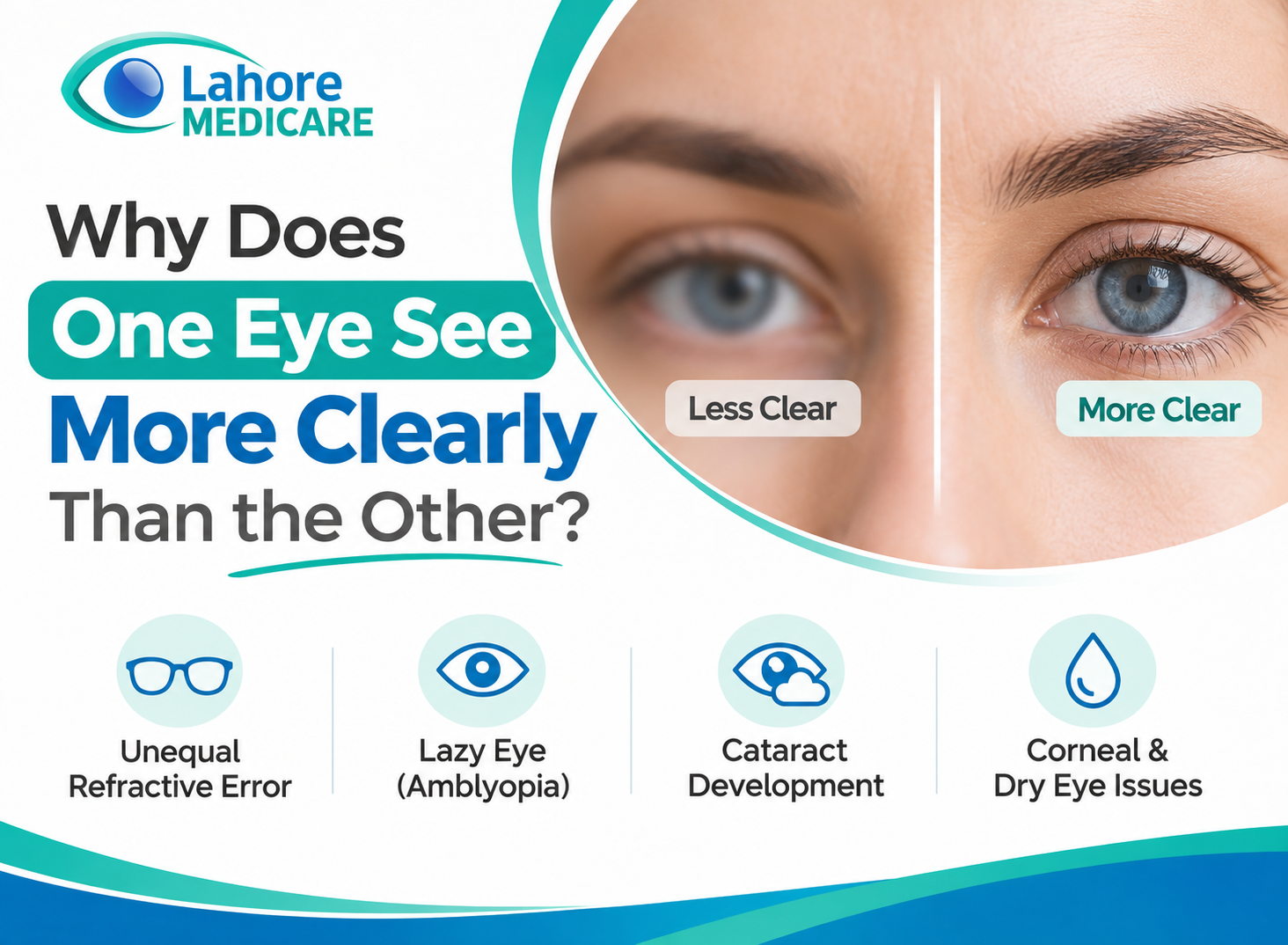
It is surprisingly common to notice that your vision is sharper or more detailed in one eye compared to the other. Many people only discover this visual imbalance when covering one eye during a routine screening, trying on sunglasses, or looking through a optical device like a camera viewfinder.
While a slight variation in visual acuity between your left and right eye is often a normal physiological difference, a distinct or sudden gap in clarity indicates an underlying optical, structural, or neurological cause that deserves attention.
Common Reasons for Asymmetrical Vision
Differences in visual clarity between eyes—medically referred to as asymmetrical vision—can range from simple refractive variations to complex structural conditions. The primary causes include:
1. Anisometropia (Unequal Refractive Error)
Anisometropia occurs when there is a significant difference in the refractive power between your two eyes. For instance, one eye may have a mild prescription while the other eye is significantly more nearsighted (myopic), farsighted (hyperopic), or affected by asymmetrical astigmatism. Because each eyeball naturally develops with slight variations in axial length or corneal curvature, light rays focus at different points behind the pupil, causing one eye to perceive images more clearly than the other.
2. Amblyopia (“Lazy Eye”)
When severe anisometropia or eye misalignment (strabismus) is present during early childhood development, the brain receives two vastly different visual inputs. To prevent double vision or visual confusion, the brain learns to favor the stronger eye and suppress processing signals from the weaker eye. Over time, the neural pathways connecting the suppressed eye to the visual cortex fail to develop fully, resulting in reduced visual acuity that persists into adulthood if untreated.
3. Asymmetrical Cataract Development
A cataract develops when the crystalline lens inside the eyeball grows cloudy. While cataracts typically affect both eyes as part of the natural aging process, they rarely progress at the exact same rate. If a cataract grows denser or more opaque in one eye first, that eye will experience accelerated blurring, muted colors, and increased glare, while the other eye retains clearer vision.
4. Corneal Irregularities and Dry Eye
The cornea—the transparent outer window of the eye—provides most of the eye’s focusing power. Conditions that affect one cornea more than the other will cause noticeable vision disparities:
- Localized Dry Eye Syndrome: An uneven tear film on one eye causes transient blurring that temporarily resolves with blinking.
- Keratoconus: A progressive condition where one cornea thins and bulges outward into an irregular cone shape faster than the other.
- Corneal Scarring: Past infections, contact lens ulcers, or physical scratches can leave localized scars that disrupt light clarity in a single eye.
5. Retinal and Macular Disorders
Because the retina lines the back of the eyeball and converts light into neural signals, unilateral retinal conditions directly impact sight in the affected eye:
- Age-Related Macular Degeneration (AMD): Macular changes or abnormal blood vessel growth often begin in one eye first, causing central blurriness or distortion.
- Diabetic Retinopathy: Microvascular bleeding or swelling (edema) can affect one retinal segment more severely.
- Retinal Vein or Artery Occlusions: A localized blood clot or blockage (“eye stroke”) rapidly reduces clarity in the affected eye.
When Should You Be Concerned?
While gradual differences in vision are often easily corrected with updated eyeglass or contact lens prescriptions, a sudden or severe drop in clarity in one eye is a medical emergency.
You should seek an immediate evaluation at a specialized center like Lahore Medicare if asymmetrical vision is accompanied by:
- Sudden Vision Loss: A rapid, painless, or painful decline in clarity in one eye over hours or days.
- Flashes and Floaters: Sudden bursts of light or a flood of new dark spots in one eye (indicating vitreous traction or a retinal tear).
- Shadow or Veil: A dark curtain blocking peripheral or central vision in one eye.
- Eye Pain or Redness: Deep aching ocular pain, severe sensitivity to light, or halo rings around lights.
Diagnostic Evaluations and Corrective Options
Pinpointing why one eye sees more clearly requires a thorough ophthalmic examination, including digital refraction, slit-lamp biomicroscopy, corneal topography, and optical coherence tomography (OCT) scans of the retina.
Depending on the underlying cause, management options include:
- Prescription Lenses: Custom eyeglasses or specialty contact lenses (such as scleral or rigid gas-permeable lenses) balance refractive differences caused by anisometropia or astigmatism.
- Vision Therapy and Patching: For pediatric amblyopia, occlusion therapy (patching the stronger eye) forces the brain to strengthen neural connections with the weaker eye.
- Targeted Ophthalmic Treatments: Cataract removal surgery, anti-VEGF intraocular injections for macular edema, or corneal cross-linking for keratoconus restore visual balance.
Evaluating structural variations alongside complex refractive and ocular diseases ensures that subtle pathology is detected early. When corrective surgical interventions or advanced diagnostic scans are needed, accessing advanced ophthalmic procedures helps protect equal visual acuity and long-term eye health.
Frequently Asked Questions
Is it normal for one eye to see better than the other?
Yes. Minor differences in vision between your left and right eyes are very common and usually result from slight variations in corneal shape, eyeball length, or minor refractive errors like mild astigmatism. However, a significant or sudden difference should be evaluated by an eye care professional.
Why does my vision seem blurry in only one eye when I wake up?
Blurry vision in one eye upon waking can be caused by sleeping directly on that side (putting temporary pressure on the cornea), localized dry eye, accumulated mucus, or mild corneal swelling. If the blurriness clears after blinking or using lubricating drops, it is usually temporary; if it persists, schedule an exam.
What is anisometropia?
is a condition where your two eyes have significantly different refractive powers. For example, one eye may be farsighted while the other is nearsighted, or one eye may require a much stronger prescription lens to achieve clear focus.
Can one eye get a cataract before the other?
Yes. Although cataracts usually develop in both eyes as part of aging, they rarely progress at the same rate. One eye can develop a significantly denser or cloudier lens much earlier, causing noticeable vision differences between eyes.
Can an eye doctor fix a lazy eye in adults?
While amblyopia (“lazy eye”) treatment is most effective in young children while neural visual pathways are still developing, modern vision therapy techniques, specialized lenses, and targeted training can still yield noticeable improvements in adult visual performance.
What causes sudden blurred vision in one eye?
Sudden blurred vision in a single eye can be caused by severe conditions such as a retinal detachment, retinal vein or artery occlusion (eye stroke), optic neuritis, acute angle-closure glaucoma, or severe corneal infection. Sudden changes require immediate emergency ophthalmic care.
How does an eye doctor test for vision differences between eyes?
Eye care specialists use monocular visual acuity charts, automated refractor scans, phoropter subjective testing, corneal topography, and dilated retinal imaging to measure and compare the optical power, structure, and health of each eye individually.
Can wearing the wrong eyeglass prescription make one eye weaker?
Wearing an incorrect eyeglass prescription will not physically damage the eye structure in adults, but it can cause severe eye strain, headaches, and fatigue. In young children, an uncorrected strong prescription in one eye can lead to permanent amblyopia.