When the eyes do not align properly, looking in different directions at the same time, the condition is medically known as strabismus, commonly referred to as a squint. While one eye focuses straight ahead on an object, the other eye may turn inward, outward, upward, or downward. This misalignment disrupts the delicate coordination needed for binocular vision, making it difficult for the brain to blend two distinct images into a single, three-dimensional view.
A major misconception is that a squint is purely a cosmetic concern or something a child will naturally outgrow. In reality, strabismus is an ocular health condition that can affect individuals of any age and requires professional assessment to restore proper alignment and preserve visual function.
What Causes a Squint?
Eye movement is controlled by six specialized extraocular muscles attached to the outside of each eyeball. For both eyes to focus on the exact same point, these muscles must work in perfect synchronization.
A squint develops when there is an imbalance or disruption in this mechanism:
- Extraocular Muscle Imbalance: Weakness, tightness, or altered physical tension in one or more eye muscles prevents synchronized movement.
- Neurological Disruption: Conditions affecting the brain signals sent along cranial nerves can impair the control of eye muscles.
- Uncorrected Refractive Errors: Severe, uncorrected farsightedness (hyperopia) can force the eye muscles to over-accommodate to pull images into focus, causing the eyes to turn inward.
- Secondary Health Conditions: In adults, sudden-onset squints can be triggered by thyroid eye disease, head trauma, stroke, or vascular changes associated with diabetes.
Classification and Types of Strabismus
Specialists classify squints based on the direction in which the misaligned eye turns:
- Esotropia: The misaligned eye turns inward toward the nose (commonly called crossed eyes).
- Exotropia: The misaligned eye turns outward toward the temple (commonly called wall-eyes).
- Hypertropia: The misaligned eye turns upward.
- Hypotropia: The misaligned eye turns downward.
A squint can be constant (present all the time) or intermittent (appearing only when tired, ill, or looking at close objects).
Key Symptoms and Diagnostic Signs
Beyond the visual appearance of misaligned eyes, strabismus produces functional visual symptoms:
- Double Vision (Diplopia): Common in adults with sudden-onset squints, occurring because the brain receives two different images from eyes pointing in different directions.
- Depth Perception Deficits: Loss of true binocular vision makes judging distances accurately more challenging.
- Eye Strain and Fatigue: Persistent aching around the eyes or headaches resulting from the extra effort required to keep the eyes aligned.
- Suppression and Lazy Eye (Amblyopia): In young children, the brain may actively suppress or ignore the image from the misaligned eye to avoid double vision, leading to reduced visual acuity in that eye over time.
Evaluating a misaligned eye requires a comprehensive diagnostic evaluation at a specialized facility like Lahore Medicare to measure the exact angle of deviation and check binocular alignment.
Treatment Options: Can a Squint Eye Be Fixed?
Yes, a squint can be successfully treated in both children and adults. The choice of treatment depends on the underlying cause, the patient’s age, and the severity of the misalignment.
Non-Surgical Treatment Approaches
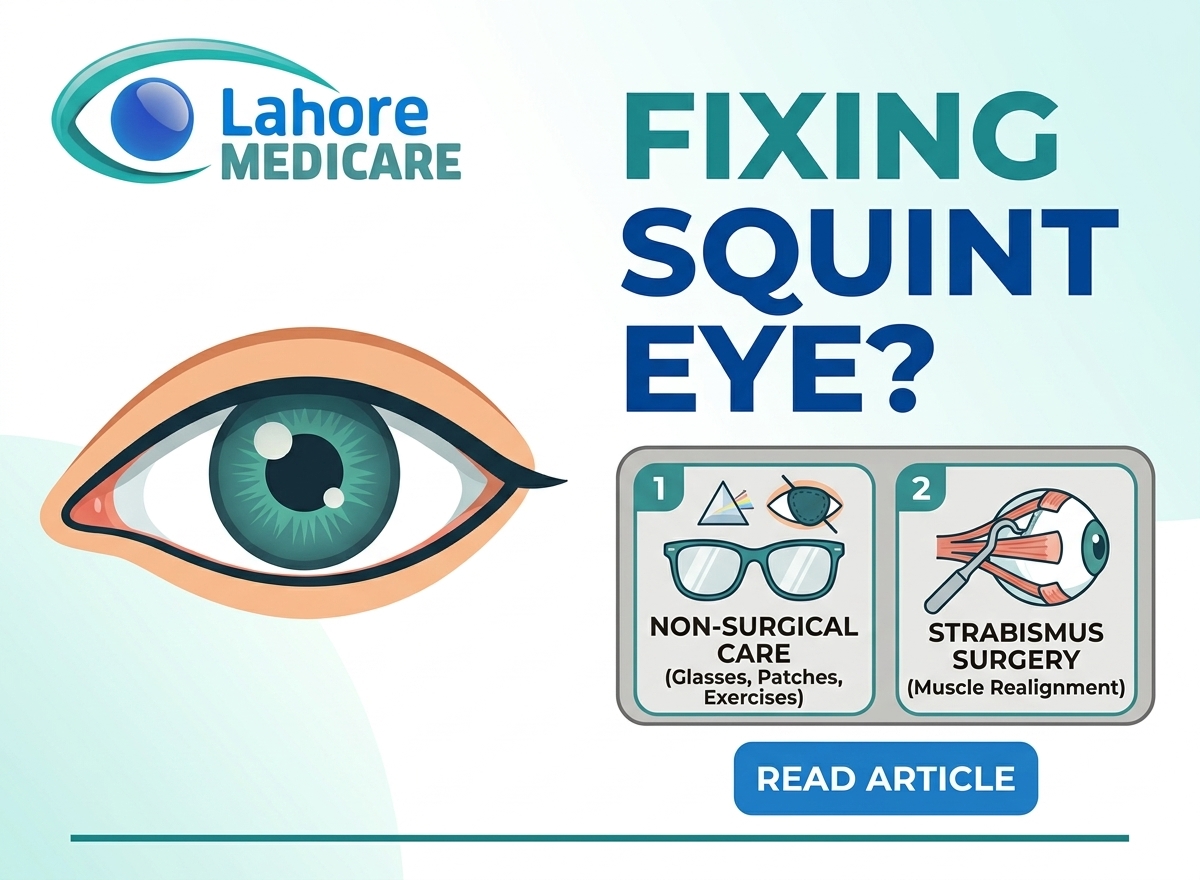
Non-surgical therapies are often the first line of defense, especially for accommodation-related or mild intermittent squints:
- Prescription Glasses or Contact Lenses: Correcting underlying refractive errors (such as farsightedness) can relieve excessive accommodation effort and naturally realign the eyes.
- Prism Lenses: Specialized glass prisms built into eyeglass lenses bend incoming light to align images on the retina, reducing double vision.
- Patching Therapy (Occlusion): Placing an adhesive patch over the stronger, aligned eye forces the brain to use the weaker or turned eye, preventing or treating amblyopia in children.
- Vision Therapy: Specific orthoptic exercises help improve eye coordination, focusing ability, and visual muscle tracking.
Surgical Realignment (Strabismus Surgery)
When non-surgical options cannot fully correct the physical misalignment, surgical intervention offers a reliable solution. Strabismus surgery involves making a tiny incision in the outer tissue of the eye to access the extraocular muscles. The surgeon then alters the tension of these muscles by shortening (resecting) them to strengthen their pull or moving their attachment site further back (receding) to weaken their action.
Individuals seeking functional alignment or cosmetic restoration can explore modern strabismus and squint correction surgery to realign the extraocular muscles.
Addressing secondary underlying causes or secondary muscle paralysis through specialized care for complex eye muscle conditions helps ensure long-term stability and optimal visual performance.
Frequently Asked Questions
Can a squint eye be fixed in adults?
Yes. Adult strabismus can be successfully treated with corrective glasses, prism lenses, vision therapy, or strabismus surgery to improve visual alignment and eliminate double vision.
What is the difference between esotropia and exotropia?
Esotropia refers to an inward turn of the misaligned eye toward the nose, whereas exotropia refers to an outward turn toward the temple.
Will a child outgrow a squint on their own?
No. Children do not outgrow a true squint. Prompt evaluation is essential to prevent lazy eye (amblyopia) and permanent loss of 3D depth perception.
What causes sudden squint in adults?
Sudden-onset strabismus in adults is often caused by nerve damage, head trauma, stroke, uncontrolled diabetes, or thyroid eye disease affecting muscle movement.
How does strabismus surgery work?
Strabismus surgery adjusts the position or length of the extraocular muscles attached to the outside of the eyeball, balancing their pull to align both eyes.
Can corrective glasses cure a squint?
If a squint is caused by an uncorrected refractive error like hyperopia, wearing the proper prescription glasses can realign the eyes without requiring surgery.
What is amblyopia (lazy eye), and how does it relate to a squint?
Amblyopia occurs when the brain ignores the visual input from a misaligned eye to avoid double vision, leading to reduced vision in that eye if left untreated during childhood.
Is squint surgery painful?
Squint surgery is typically performed under anesthesia or local sedation. Patients may feel mild soreness or a gritty sensation for a few days, which is easily managed with prescribed eye drops.
Can a squint return after surgery?
In some cases, the eyes may shift over time, requiring secondary adjustments, vision therapy, or additional corrective lenses to maintain alignment.
How does a squint affect depth perception?
Depth perception requires binocular vision, where both eyes look at the same object simultaneously. A squint prevents the eyes from working together, impairing 3D spatial judgment.