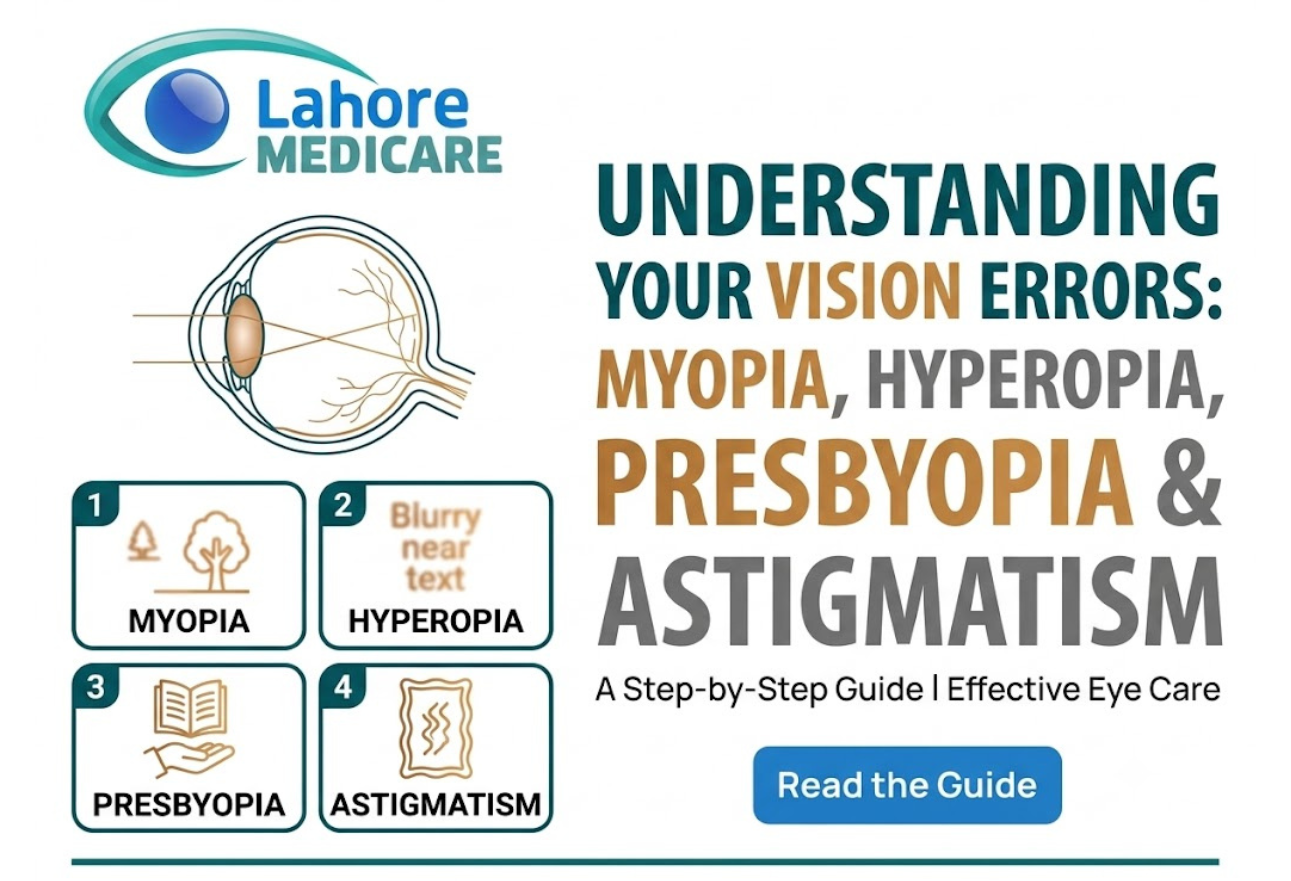
Clear vision relies on a delicate optical process. When light enters the eye, it passes through the clear outer cornea and the crystalline lens, focusing directly onto the retina—the light-sensitive layer of tissue lining the back of the eyeball. When the structural shape of the eye or cornea prevents light from bending (refracting) precisely onto the retina, the result is a refractive error.
A widespread misconception is that reading in dim light or using digital screens too long permanently causes or worsens refractive errors. In reality, these focusing issues stem primarily from physical variations in the shape of the eyeball, the curvature of the cornea, or the natural aging of the internal lens.
The Four Primary Types of Refractive Errors
While all refractive errors result in compromised visual focus, the underlying structural mechanisms differ significantly depending on the specific condition.
Myopia (Nearsightedness)
Myopia is a focusing disorder where close objects appear clear, but distant objects are blurry. This occurs when the physical eyeball is too long from front to back, or when the cornea has an excessively steep curve. Consequently, light rays come to a focal point in front of the retina rather than directly on its surface.
Myopia is usually inherited and is often first discovered during early childhood. Because the eye continues to grow alongside the rest of the body, myopia frequently progresses throughout the teenage years during rapid growth spurts before stabilizing in early adulthood.
Hyperopia (Farsightedness)
Hyperopia, or farsightedness, occurs when distant objects can often be seen clearly, but close objects appear blurred. In more pronounced cases of hyperopia, vision can become blurred at all distances. This condition develops when the eyeball is physically shorter than average or the cornea is too flat, causing light rays to focus at a theoretical point behind the retina.
Like myopia, hyperopia can also be inherited. Many young children naturally have mild hyperopia, which often lessens as the eye grows into adulthood. However, uncorrected hyperopia in adults requires the internal focusing muscles to work harder, frequently causing eye strain and fatigue during prolonged near tasks.
Presbyopia (Age-Related Near Vision Loss)
Unlike myopia or hyperopia, which stem from structural shape variations of the globe, presbyopia is a natural aging process of the internal eye lens.
After age 40, the clear lens inside the eye becomes progressively more rigid and loses its youthful flexibility. As a result, the lens can no longer flex easily to shift focus from distant objects to fine print close up. Presbyopia is a normal physiological milestone that affects everyone over time and can exist simultaneously alongside pre-existing myopia, hyperopia, or astigmatism.
Astigmatism (Uneven Corneal Curvature)
Astigmatism occurs when the front surface of the eye (the cornea) or the internal lens has an irregular, asymmetrical shape. Instead of being shaped like a perfectly round basketball, an astigmatic cornea is curved more like an egg or rugby ball. This uneven curvature prevents light from focusing to a single sharp point on the retina, causing distorted, double-contoured, or blurred vision at all distances.
Common Symptoms and How Refractive Errors Are Diagnosed
Recognizing the early indicators of a refractive error ensures you seek timely optical correction before unnecessary physical discomfort develops. Common warning signs include:
Blurry vision when viewing far away, up close, or both
Persistent eye strain, burning sensations, or visual fatigue
Frequent headaches triggered by prolonged reading or screen work
Squinting or tilting the head to bring images into clearer focus
Difficulty driving at night due to glare, halos, or blurred lights
Diagnosing a refractive error requires a comprehensive eye exam. Specialists evaluate visual acuity using standardized charts and use phoropters and automated refractometers to measure precisely how light bends through your optical system.
If you suspect changes in your focusing power, scheduling an evaluation at a specialized facility like Lahore Medicare provides a clear baseline of your optical health.
Modern Treatment and Vision Correction Options
Refractive errors cannot be cured by eye exercises or diet, but they can be easily corrected using non-invasive optical devices or permanent surgical restructuring.
Prescription Eyeglasses and Contact Lenses
Eyeglasses remain the simplest, safest method to correct vision. Concave lenses correct myopia by pushing the light focus back onto the retina, convex lenses assist hyperopia and presbyopia by bending light inward, and cylindrical lenses offset the uneven curves of astigmatism. Specialized contact lenses sit directly on the tear film, providing a wider peripheral field of view.
Advanced Surgical Procedures
For individuals seeking freedom from glasses or contact lenses, modern refractive procedures permanently reshape the cornea or modify the eye’s internal lens system. Patients seeking long-term visual clarity can explore modern refractive surgery procedures to correct structural focusing errors.
When refractive symptoms overlap with secondary ocular conditions or early lens changes, receiving specialized care for complex eye diseases and conditions ensures that all structural layers of the eye are thoroughly evaluated and protected.
Frequently Asked Questions
Does staring at digital screens cause refractive errors?
No. Overuse of the eyes or looking at digital screens does not cause or permanently worsen refractive errors. Screen work can cause temporary digital eye strain and dry eyes, but actual refractive errors stem from physical eye shape and genetics.
What is the difference between myopia and hyperopia?
In myopia (nearsightedness), close objects are clear while distant objects are blurry. In hyperopia (farsightedness), distant objects are usually clear, but near vision requires extra effort and appears blurred.
Why do I suddenly need reading glasses after age 40?
This change is caused by presbyopia, a natural aging process where the eye’s internal lens loses its flexibility. Because the rigid lens can no longer flex to focus up close, reading glasses are needed to bring near text into focus.
Can a person have astigmatism along with nearsightedness?
Yes. Astigmatism refers to an irregular curvature of the cornea or lens and can easily exist at the same time as myopia, hyperopia, or presbyopia. Prescription lenses are designed to correct both conditions simultaneously.
Why does myopia often get worse during teenage years?
Myopia frequently progresses throughout the teenage years because the physical eyeball grows rapidly alongside the rest of the body. As the elongation of the eyeball increases, the optical focus shifts further in front of the retina.
Can children outgrow farsightedness?
Yes. Many young children are born with mild hyperopia because their eyes are naturally short. As the child grows and the eyeball lengthens toward adult dimensions, the hyperopia often lessens or resolves naturally.
What are the main symptoms of uncorrected refractive errors?
Common symptoms include blurry or distorted vision, frequent headaches, eye fatigue, squinting to see clearly, and difficulty reading or driving, especially during low-light conditions at night.
Can presbyopia be prevented with eye exercises?
No. Presbyopia is caused by the biological hardening of the crystalline lens protein over time. Because it is a natural aging structural change rather than muscle weakness, eye exercises cannot prevent or reverse presbyopia.
How do corrective lenses fix astigmatism?
Corrective lenses for astigmatism feature a custom cylindrical shape that counteracts the uneven curve of the cornea. This allows incoming light rays to bend evenly and converge onto a single sharp focal point on the retina.
How often should I get my vision checked for refractive changes?
Adults should undergo a comprehensive eye examination every one to two years, or sooner if they notice sudden blurriness, persistent eye strain, headaches, or difficulty performing routine near and distance visual tasks.