Experiencing unexpected blurriness when reading a menu, looking at a street sign, or working on a computer is one of the most common reasons people seek medical eye evaluations. While sudden vision changes can sometimes indicate underlying medical conditions, persistent or gradual blurriness is overwhelmingly caused by refractive errors. Refractive errors occur when the physical structure of the eye prevents light from focusing directly onto the retina, the light-sensitive tissue lining the back of the eyeball.
Understanding why your vision is out of focus helps clear up common misconceptions and guides you toward the most effective vision correction solutions.
How Refractive Errors Cause Blurry Vision
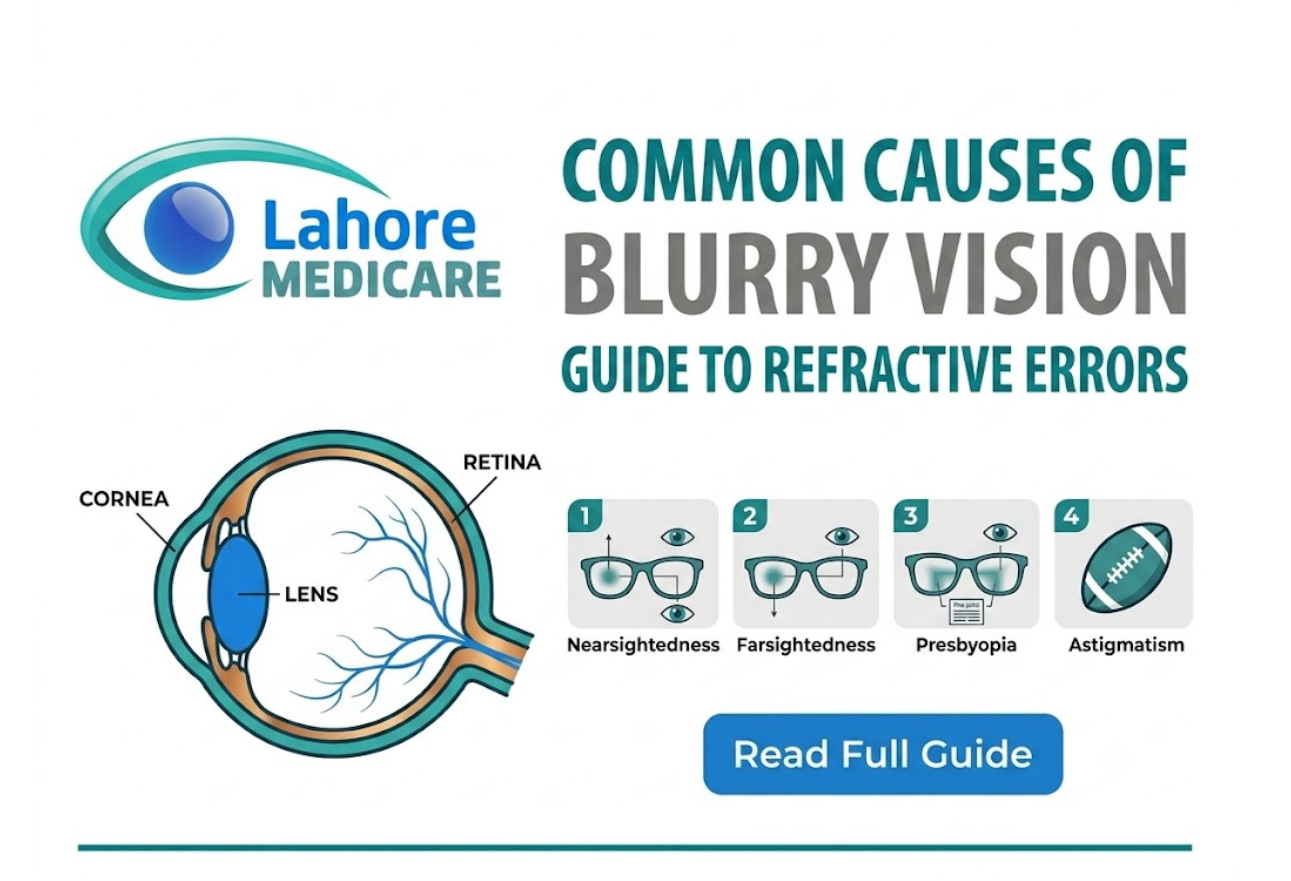
To see clearly, light rays must pass through the front window of the eye (the cornea) and the crystalline lens. These two structures bend (refract) incoming light rays so that they meet at a single, sharp focal point directly on the retina. The retina then transforms these light signals into nerve impulses that travel through the optic nerve to the brain.
When the physical shape of the eyeball is too long or too short, or when the curve of the cornea is irregular, light rays focus either in front of or behind the retina. This misalignment creates a hazy or out-of-focus image.
The Four Primary Types of Refractive Errors
There are four major types of refractive errors that cause everyday vision blurring, each arising from a distinct structural variation within the eye.
1. Myopia (Nearsightedness)
Myopia makes distant objects appear blurry while near objects remain clear. This develops when the eyeball grows too long from front to back or when the cornea has a steep curvature. As a result, incoming light rays converge in front of the retina instead of directly on its surface. Myopia typically begins in childhood, often progressing through the teenage growth years before stabilizing in early adulthood.
2. Hyperopia (Farsightedness)
Hyperopia typically allows distant objects to be seen more clearly, while close objects appear blurry or cause significant strain. In more pronounced cases, objects at all distances can look hazy. Farsightedness occurs when the physical eyeball is shorter than average or the cornea is too flat, causing light rays to focus at a point behind the retina. Adults with uncorrected hyperopia often experience muscle fatigue as the internal focusing system works constantly to pull images into focus.
3. Presbyopia (Age-Related Near Blurred Vision)
If you find yourself holding books or phones at arm’s length after reaching your 40s, presbyopia is usually the cause. Unlike myopia or hyperopia, which stem from the shape of the eyeball, presbyopia is a natural physiological change caused by aging. As the eye matures, the internal crystalline lens becomes less flexible, making it difficult for the eye muscles to flex the lens for close-up reading tasks. Presbyopia affects everyone over time, regardless of whether they previously had perfect vision.
4. Astigmatism (Distorted Vision at All Distances)
Astigmatism occurs when the front surface of the eye (the cornea) or the natural lens has an asymmetric, football-like curvature instead of a round basketball shape. This uneven surface causes light rays to bend unequally in different directions, preventing a single focal point on the retina. Consequently, images appear blurry, stretched, or double-contoured at both near and far distances.
Recognizing Symptoms Beyond Blurry Sight
While blurred vision is the defining sign of a refractive error, uncorrected visual focus often triggers secondary physical discomfort as your eyes work overtime to compensate. Key indicators include:
- Frequent squinting, blinking, or tilting the head to see clearly
- Persistent eye fatigue, burning, or aching after reading or computer work
- Dull frontal headaches that worsen toward the end of the day
- Difficulty seeing clearly while driving at night due to glare and starbursts around lights
- Frequent loss of focus or skipping lines while reading fine print
If you experience persistent visual strain or blurriness, obtaining a professional clinical assessment at a established facility like Lahore Medicare provides a clear diagnosis and path forward.
Effective Solutions for Refractive Blur
Fortunately, refractive errors are among the easiest vision issues to evaluate and correct. Modern optometry and ophthalmology offer multiple reliable methods to restore sharp vision.
Corrective Lenses
Eyeglasses remain the most reliable, non-invasive method for restoring sharp focus. Custom lenses bend incoming light before it enters the eye, offsetting structural variations so light lands directly on the retina. Contact lenses perform the same function directly on the tear film, offering an unobstructed peripheral field of view.
Advanced Surgical Options
For patients seeking long-term freedom from corrective eyewear, modern procedures permanently reshape the corneal surface or replace the internal lens. Exploring tailored refractive surgery procedures can help permanently correct focal issues and restore natural visual clarity.
When blurry vision is accompanied by secondary ocular symptoms or structural lens changes, receiving specialized care for complex eye conditions and diseases ensures that all inner structures of the eye are thoroughly evaluated and protected.
Frequently Asked Questions
Why does my vision get blurry when I look at close objects?
Blurry near vision is typically caused by hyperopia (farsightedness) in younger individuals or presbyopia in adults over 40. Presbyopia occurs when the natural lens inside the eye becomes less flexible, making close focus difficult.
Can reading in low light or using screens cause permanent refractive errors?
No. Staring at screens or reading in dim lighting causes temporary digital eye strain, dryness, and fatigue, but it does not permanently alter the physical shape of your eye or cause true refractive errors.
What is the main difference between myopia and astigmatism?
Myopia causes blurriness primarily when looking at distant objects due to an elongated eyeball. Astigmatism causes blurry or distorted vision at all distances due to an irregular, asymmetrical curve of the cornea or lens.
How do eye specialists test for refractive errors?
Eye specialists use standardized visual acuity charts, automated refractometers, and phoropters during a comprehensive eye exam. These tools measure exactly how light bends through your optical system to determine your lens prescription.
Can a person have both myopia and astigmatism at the same time?
Yes. Astigmatism describes an irregular corneal curve and frequently occurs alongside nearsightedness (myopia) or farsightedness (hyperopia). Prescription lenses can easily correct both conditions simultaneously.
At what age does presbyopia usually begin?
Presbyopia typically becomes noticeable in a person’s early-to-mid 40s. It progresses gradually until around age 65, when the lens flexibility stabilizes.
Can children outgrow farsightedness?
Yes. Many young children are naturally slightly farsighted because their eyes are small. As the child grows and the eyeball lengthens toward adult size, mild hyperopia often resolves on its own.
What are the signs that I need vision correction for refractive errors?
Key signs include persistent blurred vision at distance or near, frequent headaches, visual fatigue after reading, squinting to bring objects into focus, and trouble driving safely at night.
How do glasses correct astigmatism?
Eyeglass lenses designed for astigmatism feature a specialized cylindrical power that compensates for the uneven curve of the cornea, focusing light evenly onto a single sharp point on the retina.
How often should I update my vision prescription?
Adults should get a comprehensive eye exam every one to two years. If you notice gradual blurriness, frequent eye strain, or headaches, schedule an evaluation sooner to adjust your prescription.