Living with dependent vision means structuring your entire day around a pair of prescription glasses or contact lenses. From the moment you wake up, basic activities like reading a message on your phone, driving through busy city streets, or working on a computer screen require constant optical assistance. For many individuals across Pakistan, this continuous reliance leads them to explore a permanent alternative. Modern ophthalmic technology allows individuals to change the way their eyes focus light, providing a path toward clear, independent sight.
The Relationship Between Eye Anatomy and Visual Focus
To understand how vision can be corrected permanently, it is essential to look at how a healthy eye processes visual information from the surrounding environment. In eyes with normal vision, the cornea bends (refracts) light precisely onto the retina at the back of the eye. This exact alignment acts like a finely tuned camera lens, translating physical light waves into crisp, beautifully detailed images that our brains can decode instantaneously.
However, when the structural dimensions of the eyeball or the curvature of the front window are slightly off, light cannot land where it belongs. But with nearsightedness (myopia), farsightedness (hyperopia) or astigmatism, the light is bent incorrectly, resulting in blurred vision. While standard prescription glasses or contact lenses can correct vision by pre-bending light before it reaches your eye, reshaping the cornea itself also will provide the necessary refraction. This biological alteration addresses the root mechanical cause of the blurriness rather than just filtering it externally.
Breaking Down the Three Major Refractive Errors
Most vision problems stem from minor variations in the physical shape and length of the eye structures. These variations fall into three distinct categories, each impacting your daily activities differently depending on how light travels through your optical pathways.
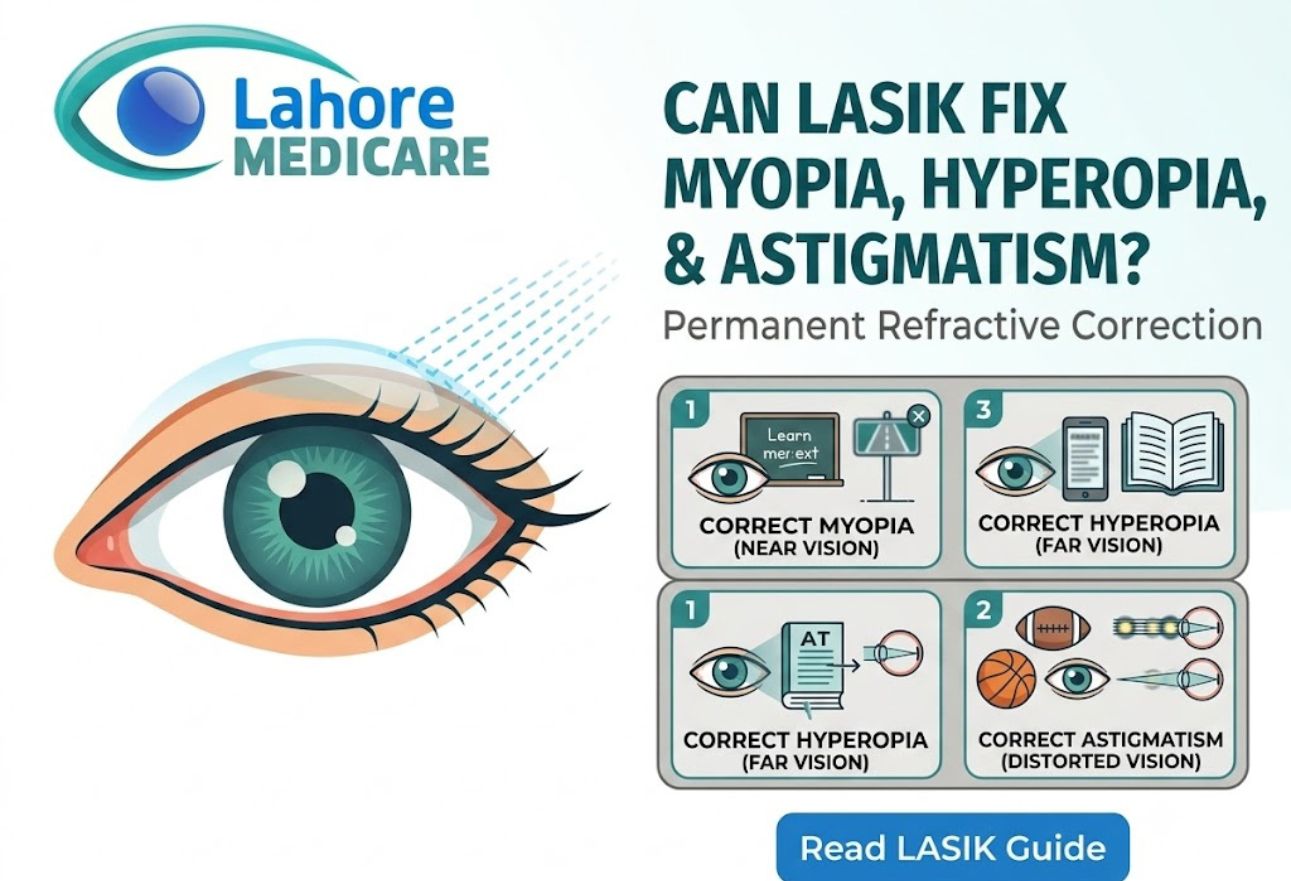
- Nearsightedness (myopia): When your eyeball is slightly longer than normal or when the cornea curves too sharply, light rays focus in front of the retina and blur distant vision. You can see objects that are close fairly clearly, but not those that are far away. This makes tasks like reading a chalkboard or identifying road signs during an evening drive incredibly difficult.
- Farsightedness (hyperopia): When you have a shorter than average eyeball or a cornea that is too flat, light focuses behind the retina instead of on it. This makes near vision, and sometimes distant vision, blurry. Individuals with hyperopia often experience intense eye strain and chronic headaches when trying to focus on close-up computer work or reading material.
- Astigmatism: When the cornea curves or flattens unevenly, the result is astigmatism, which disrupts focus of near and distant vision. Instead of being perfectly round like a basketball, an astigmatic cornea is shaped more like a football, causing light to stretch and distort across multiple focal points.
Catching these structural changes early through regular checkups at a comprehensive medical care facility like Lahore Medicare helps track how these errors develop over time. Understanding your precise prescription is the vital foundation required before considering any permanent corrective options.
The Precision Technology behind Corneal Reshaping
For individuals looking to eliminate the daily maintenance, cleaning, and discomfort associated with contact lenses or frames, advanced laser treatments offer a highly reliable medical solution. LASIK eye surgery is the best known and most commonly performed laser refractive surgery to correct vision problems. Laser-assisted in situ keratomileusis (LASIK) can be an alternative to glasses or contact lenses for qualifying candidates.
During LASIK surgery, a special type of cutting laser is used to precisely change the shape of the dome-shaped clear tissue at the front of your eye (cornea) to improve vision. The procedure works by gently lifting a microscopic, protective flap on the surface of the eye, allowing the cold computer-guided laser to painlessly remove tiny amounts of tissue. By flattening a sharply curved cornea for nearsighted patients, steepening a flat cornea for farsighted patients, or smoothing out irregularities for those with astigmatism, the laser permanently alters how light behaves inside your eye.
A Common Misconception: Many patients believe laser treatment is only for basic nearsightedness. In reality, modern advanced excimer lasers are highly versatile and engineered to simultaneously correct complex combinations of myopia, hyperopia, and astigmatism in a single session.
What to Expect and Finding Your Correct Treatment Path
Choosing to undergo a corrective procedure is a significant personal decision that requires deep clinical insight rather than a generalized approach. Because every individual’s corneal thickness, surface curvature, and lifestyle requirements are entirely unique, a detailed pre-operative evaluation is non-negotiable. This diagnostic process maps the exact structural topography of your eye to ensure long-term safety and success.
| Procedural Phase | Main Focus | Typical Experience |
| Pre-Op Evaluation | Cornea mapping & thickness check | Completely painless, detailed measurements |
| Laser Reshaping | Active corneal restructuring | Complete within minutes using numbing drops |
| Initial Recovery | Cellular surface healing | Rapid stabilization within 24 to 48 hours |
For residents exploring their options locally, scheduling a comprehensive assessment for custom Treatment by LASIK in lahore ensures that your eyes are thoroughly screened by experienced professionals. Taking the time to understand the modern clinical Procedures of treatment For lahore patients allows you to approach your visual transformation with absolute confidence, paving the way for a life of vibrant, crisp, and independent sight.
Frequently Asked Questions
Can LASIK fix nearsightedness and astigmatism at the same time?
Yes. Modern laser technology is fully capable of addressing multiple refractive errors simultaneously. The specialized laser can smooth out the uneven curvature of astigmatism while adjusting the overall steepness to fix myopia in one fast procedure.
How does a laser safely reshape the human cornea?
The surgical system utilizes a highly precise, cool ultraviolet laser beam. This specialized cutting laser removes microscopic amounts of tissue from the corneal dome without generating heat, safely changing its shape to properly focus traveling light rays.
Is the visual correction from a LASIK procedure permanent?
Yes, the physical reshaping of the corneal tissue is a permanent alteration. While your eye structures can still undergo natural, age-related internal shifts later in life, the structural changes made by the laser do not wear off.
Why does myopia cause far-away objects to look blurry?
In a myopic eye, the physical eyeball is too long or the cornea is too steep. This causes incoming light rays to focus at a point in front of the retina rather than directly on it, blurring distant images.
What makes a person a good candidate for laser eye surgery?
An ideal candidate is an adult with a stable vision prescription for at least one year, healthy corneal thickness, and an absence of underlying progressive ocular conditions like severe dry eye syndrome or advanced cataracts.
Does farsightedness only affect your close-up vision?
Not always. While mild hyperopia mainly causes close-up objects to appear blurry due to light focusing behind the retina, severe farsightedness can strain the eye’s natural focusing system so much that distant objects become blurry as well.
How long does the actual laser reshaping part take?
The laser application itself is incredibly brief, typically requiring less than a minute per eye to complete the precise tissue adjustments. The entire process, including setup and preparation, takes about fifteen minutes.
Can a child undergo a laser vision correction procedure?
No, laser vision correction is not recommended for children. Because a child’s eyes are still growing and their prescription changes continuously during development, surgery must wait until vision stabilizes in adulthood.
What happens if my cornea is found to be too thin for LASIK?
If a pre-operative evaluation reveals that your cornea is too thin to safely create a standard surface flap, specialists can recommend highly effective alternative procedures like PRK or Trans-PRK that reshape the surface without a flap.
How soon can patients return to work after the procedure?
The vast majority of patients experience rapid visual stabilization and can comfortably return to their normal work routines and driving within 24 to 48 hours after the procedure, following basic care guidelines.