
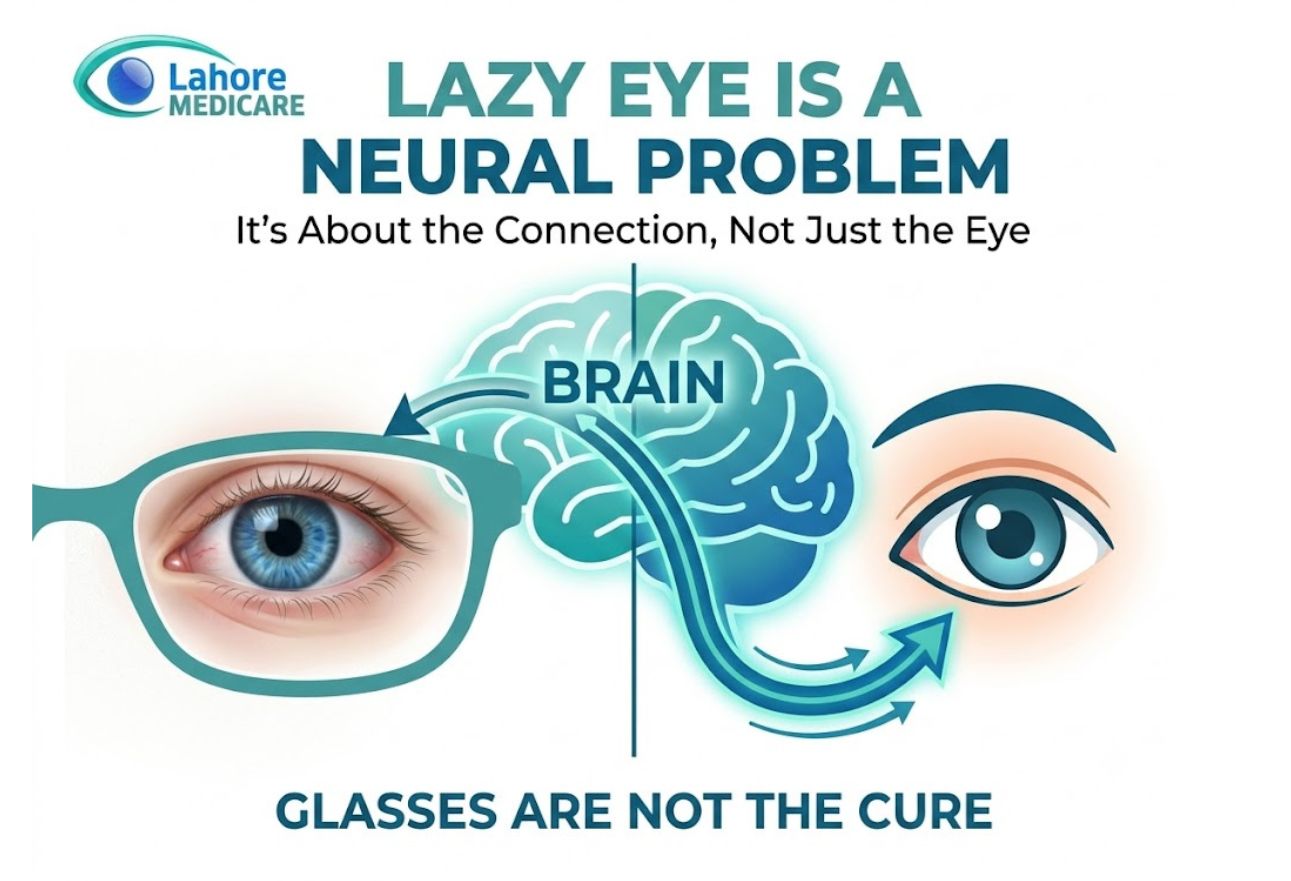
Discovering that your child is struggling with their vision can be a concerning moment for any parent. Many parents assume that buying a pair of prescription glasses will instantly clear up any blurry vision or alignment issues their child faces. However, when a child is diagnosed with amblyopia, commonly known as lazy eye, families are often surprised to find out that glasses alone do not resolve the issue. Understanding why this happens requires a deeper look into how the eyes and the brain learn to communicate during early childhood development.
The Hidden Nature of Amblyopia
Amblyopia is a highly misunderstood vision condition because it does not stem from a physical disease within the eye structures themselves. Instead, it is a developmental issue involving the neural pathways between the eye and the brain.
Amblyopia, commonly known as lazy eye, causes more visual loss in the under 40 age group than all the injuries and diseases combined in this age group. Despite its prevalence, it often goes unnoticed because the eye itself looks completely healthy from the outside. Amblyopia, commonly known as lazy eye, is the eye condition noted by reduced vision not correctable by glasses or contact lenses and is not due to any eye disease. The brain, for some reason, does not fully acknowledge the images seen by the amblyopic eye.
This lack of acknowledgement happens because the brain prefers the clearer visual signals coming from the stronger eye, effectively ignoring the weaker input. This almost always affects only one eye but may manifest with reduction of vision in both eyes. Because the stronger eye compensates so well for daily tasks, children rarely complain of discomfort. It is estimated that three percent of children under six have some form of amblyopia, making early clinical assessments crucial for families across Pakistan.
Why Standard Vision Screenings Fail to Detect Lazy Eye
A common mistake many families make is relying solely on basic physical checkups or quick school checkups to verify their child’s vision health. While a standard eye chart test can tell you if a child can read letters from a distance, it fails to assess how well the eyes operate as a coordinated team.
Comprehensive vision examinations are needed for infants, toddlers, and pre-school children. A pediatrician’s eye exam or a 20/20 eye chart screening is not adequate for the detection of amblyopia and other visual conditions which are related to or mistakenly called lazy eye. A child might pass a basic school chart test with excellent marks by using their dominant eye while the weaker eye continues to deteriorate unvetted.
At Lahore Medicare, advanced diagnostic protocols evaluate binocular vision, focusing flexibility, and eye tracking. This deep level of clinical analysis is the only reliable way to catch suppression trends before they impact the child’s long-term visual potential.
The Long-Term Impact on Visual Development
When the brain consistently ignores the input from one eye, the physical structure of the eye remains normal, but the visual processing areas of the brain fail to develop fully. This creates a true functional deficit that extends far beyond simple blurriness.
Lazy Eye is an eye condition in which there is blurry or reduced vision that is not correctable by glasses, contact lenses or eye surgery. Because the condition changes the way the brain builds its visual map of the world, lazy eye can cause loss of vision, including loss of depth perception and two-eyed 3D vision.
Without proper depth perception, everyday activities like catching a ball, climbing stairs safely, tracking lines of text on a page, or judging distances while driving later in life can become significantly more difficult. This highlights why identifying the issue during early childhood is so critical for a child’s future academic and physical milestones.
Modern Approaches to Lazy Eye Treatment
For decades, an old medical myth suggested that if a lazy eye was not corrected by age seven or eight, the visual deficit was permanent. Modern neuroscience has completely disproven this limitation, bringing immense hope to older children and adults who grew up with untreated vision issues.
Lazy eye treatment can yield improvements at any age, but early detection and treatment still offer easier treatment and the best chances for a cure. Scientific research has proven that lazy eye treatment can be successful in older children, teenagers, and adults. Neuroscience has established that the human brain can change at any age, a concept known as neuroplasticity. This means that with targeted therapy, the brain can still learn to process images from the weaker eye.
When parents seek specialized lazy eye Treatment in lahore, the approach extends far beyond simply wearing a stronger lens. Corrective strategies often involve patching the dominant eye to force the brain to use the weaker one, or engaging the patient in specialized vision therapy exercises. Understanding the diverse clinical Procedures of treatment available today allows families to take a proactive approach to restoring balanced, three-dimensional vision at any stage of life.
Frequently Asked Questions
Why can’t laser eye surgery fix a lazy eye?
Laser eye surgery reshapes the cornea to fix physical focusing errors like nearsightedness. However, because amblyopia is a neural problem where the brain suppresses the eye’s signals, altering the physical surface of the eye cannot fix the brain’s processing issue.
How does patching help treat amblyopia?
By placing a temporary patch over the stronger, dominant eye, you force the brain to stop ignoring the weaker eye. This stimulation strengthens the neural pathways between the lazy eye and the brain, gradually improving functional visual acuity over time.
Can a child develop amblyopia if their eyes look perfectly straight?
Yes. While crossed or misaligned eyes (strabismus) are a well-known cause, amblyopia can also be caused by a significant difference in prescription between the two eyes. In these cases, the eyes look normal, but one eye sees a blurrier image.
What age is best to begin lazy eye treatment?
The absolute best window is under the age of six because the visual system is highly adaptable. However, due to the brain’s natural neuroplasticity, successful treatment can still be achieved in teenagers and adults with dedicated therapy.
What is the difference between strabismus and amblyopia?
Strabismus refers to a physical misalignment where the eyes turn inward, outward, or cross. Amblyopia is the actual reduction in vision clarity that happens when the brain suppresses one eye, which can occur as a direct result of strabismus.
Can an adult benefit from lazy eye therapy?
Yes. Thanks to neuroscience research into neuroplasticity, we now know the adult brain retains the ability to rewire its visual processing pathways. Adult treatment takes more time and effort than childhood therapy, but significant improvements are possible.
What happens if amblyopia is left completely untreated?
Untreated amblyopia can lead to permanent visual deficits in the affected eye, including a permanent loss of depth perception and 3D vision. It also increases the risk of severe vision loss if the patient’s remaining good eye is ever injured.
Why did my doctor prescribe glasses if they won’t fully fix the lazy eye?
Glasses are often the necessary first step to ensure the brain receives the clearest possible physical image. While glasses alone won’t cure the underlying neural suppression, they provide the essential foundation needed for patching or vision therapy to work.
Can a child inherit a lazy eye from their parents?
Yes, there is a strong genetic component. If parents or close relatives have a history of amblyopia, strabismus, or extremely high optical prescriptions, children should receive a comprehensive eye exam at an early age to rule out developmental delays.
How long does typical lazy eye treatment take to show results?
Treatment duration varies based on the child’s age and the severity of the suppression. Some children show noticeable improvements in vision clarity within a few months of consistent patching and vision therapy, while others require longer care.