
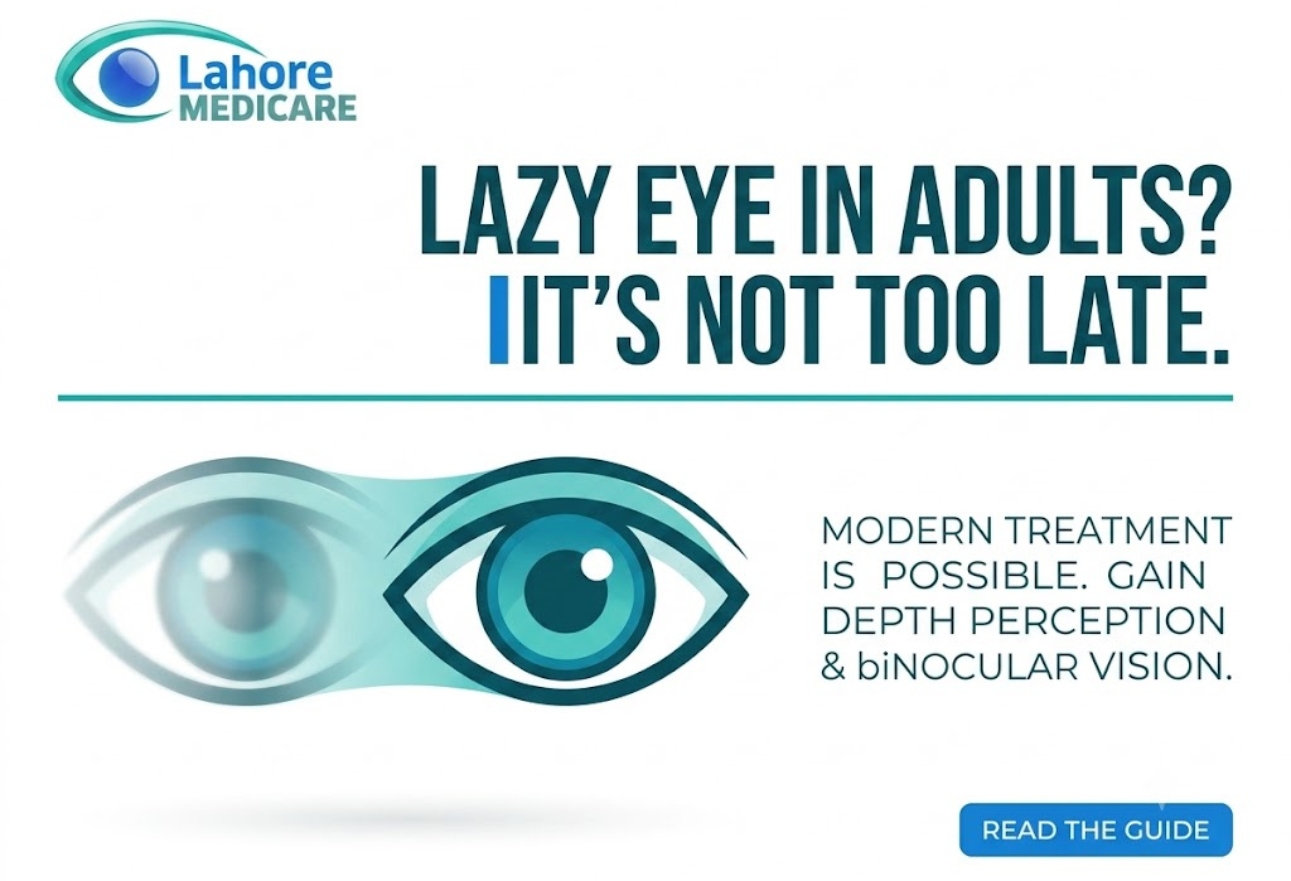
For decades, conventional wisdom suggested that if you didn’t correct a lazy eye during early childhood, you were stuck with it for life. Many adults grew up believing that after a certain age, the brain and eyes lose their ability to adapt, leaving them to navigate the world with permanently compromised vision. This belief left countless individuals frustrated, struggling with basic tasks that require sharp binocular sight.
Fortunately, modern medical science has completely reshaped our understanding of this condition. If you are an adult living with a lazy eye, the short answer is no, it is not too late. Recent scientific breakthroughs prove that the mature visual system is far more adaptable than previously thought, opening new doors for adults seeking to improve their eyesight.
Understanding Amblyopia and Its Real Impact
To understand how treatment works for adults, it is necessary to examine what the condition actually is. Amblyopia, commonly known as lazy eye, is the eye condition noted by reduced vision not correctable by glasses or contact lenses and is not due to any eye disease. Instead of a structural problem within the eye itself, it is a neurological disconnect. The brain, for some reason, does not fully acknowledge the images seen by the amblyopic eye, favoring the stronger eye instead.
While this almost always affects only one eye, it may manifest with a reduction of vision in both eyes. The impact of this condition on young adults is staggering but rarely talked about openly. In fact, amblyopia causes more visual loss in the under 40 age group than all the injuries and diseases combined in this age group.
Lazy eye is an eye condition in which there is blurry or reduced vision that is not correctable by glasses, contact lenses, or eye surgery. Because the brain struggles to merge the two separate images it receives from the eyes, lazy eye can cause loss of vision, including loss of depth perception and two-eyed 3D vision. This makes everyday activities like catching a ball, driving safely, or tracking text across a page incredibly taxing for an adult.
The Myth of the Hardwired Adult Brain
The main reason adults were historically denied care was the concept of the “critical period.” Doctors believed that after age seven or eight, the visual pathways between the eye and the brain became permanently fixed. If the brain had not learned to process images from the weaker eye by then, it was assumed it never would.
However, modern neuroscience has shattered this old timeline. Scientific research has proven that lazy eye treatment can be successful in older children, teenagers, and adults. Neuroscience has established that the human brain can change at any age—a concept known as neuroplasticity.
While a child’s brain is naturally more flexible, adult brains still retain the capacity to forge new neural pathways and reorganize existing ones. This means that with targeted stimulation and exercises, an adult brain can relearn how to accept, process, and interpret high-quality visual signals coming from the amblyopic eye.
Modern Treatment Options for Adults
Because adult treatment relies on neuroplasticity, it looks quite different from traditional childhood therapies. While patching the stronger eye is still used occasionally, modern protocols focus heavily on active vision therapy. These treatments train both eyes to work together as a synchronized team, targeting the root cause of the neurological suppression.
Adult care typically involves specialized computer programs, virtual reality games, and binocular viewing tasks that force the brain to utilize both eyes simultaneously to complete a visual puzzle. These interactive therapies strengthen the weaker eye while teaching the brain to drop its defense mechanism of suppressing the amblyopic image.
When exploring specialized clinical options, patients can find customized lazy eye Treatment in lahore designed to address these specific neurological connection issues. Depending on the underlying cause, such as a severe muscle misalignment or a massive prescription imbalance, physicians can determine the safest and most efficient path forward.
Understanding the various Procedures of treatment available at a specialized facility helps patients make informed decisions about their clinical care journey.
The Critical Value of Proper Screening
While treatment brings life-changing improvements to adults, the medical community still emphasizes the importance of catching visual discrepancies as early as possible. It is estimated that three percent of children under six have some form of amblyopia. Lazy eye treatment can yield improvements at any age, but early detection and treatment still offer easier treatment and the best chances for a cure.
The biggest hurdle in eradicating this condition early is the inadequacy of basic vision screenings. Comprehensive vision examinations are needed for infants, toddlers, and pre-school children. A pediatrician’s eye exam or a 20/20 eye chart screening is not adequate for the detection of amblyopia and other visual conditions which are related to or mistakenly called lazy eye.
A standard chart screening only checks how well a child can read letters from a distance with both eyes open. If one eye is exceptionally strong, it completely masks the weakness of the lazy eye, allowing the child to pass the test while the brain-eye connection continues to deteriorate. A true diagnostic evaluation requires a visit to a dedicated ophthalmic center like Lahore Medicare, where advanced equipment measures how the eyes track, focus, and work in unison.
Living with a lazy eye as an adult can feel isolating, but your visual story is not set in stone. Whether your goal is to gain better depth perception for sports, reduce daily eye strain at your computer, or simply feel more confident in your vision, the adult brain is fully capable of learning to see the world clearly.
Frequently Asked Questions
Why can’t standard glasses fix a lazy eye in adults?
Glasses correct physical focusing errors inside the eye itself, like astigmatism. Lazy eye is a neurological issue where the brain rejects the image from that eye, so changing the lens in front of the eye doesn’t fix the brain’s processing error.
What exactly is neuroplasticity in adult eye care?
Neuroplasticity is the brain’s natural ability to reorganize itself by forming new neural connections throughout life. This allows adults to train their brains to accept visual data from a lazy eye, even after decades of suppression.
How does a lazy eye affect an adult’s daily depth perception?
True depth perception requires both eyes to send aligned images to the brain. Because a lazy eye is ignored by the brain, adults often struggle to judge distances accurately, making parking, pouring liquids, or playing sports difficult.
Can a sudden eye injury cause amblyopia in a 30-year-old?
No. Amblyopia develops during early childhood when the visual pathways are forming. If an adult experiences a sudden loss of vision after an injury, it is due to physical tissue damage or disease, not a developmental lazy eye.
Is a 20/20 vision chart test enough to detect a lazy eye?
No, distance charts are inadequate. A person can pass a basic chart test by using their dominant eye while the weaker eye lags behind. A comprehensive exam is required to test how well the eyes track and work together.
How long does adult lazy eye therapy typically take?
The timeline varies depending on the severity of the suppression, but most adults require several months of consistent, targeted vision therapy exercises to see noticeable improvements in their binocular vision and depth perception.
Are virtual reality games actually used to treat lazy eye?
Yes. Modern vision therapy utilizes specialized VR programs that present different images to each eye simultaneously. This forces the brain to actively use the lazy eye to complete the game, accelerating the recovery process.
Can squint surgery cure a lazy eye in adults?
Surgery can physically straighten misaligned eye muscles to improve appearance, but it does not automatically fix the vision processing issue. Vision therapy is usually required after surgery to teach the brain to use the straightened eye.
What percentage of young children suffer from amblyopia?
It is estimated that roughly three percent of all children under the age of six experience some form of amblyopia, making early pediatric eye examinations vital for preventing long-term development issues.
Does a lazy eye get progressively worse if left untreated?
While the vision loss usually stabilizes after childhood, an adult may notice increased eye strain, headaches, and worsening depth perception as the dominant eye gets fatigued from overcompensating for the weaker one.