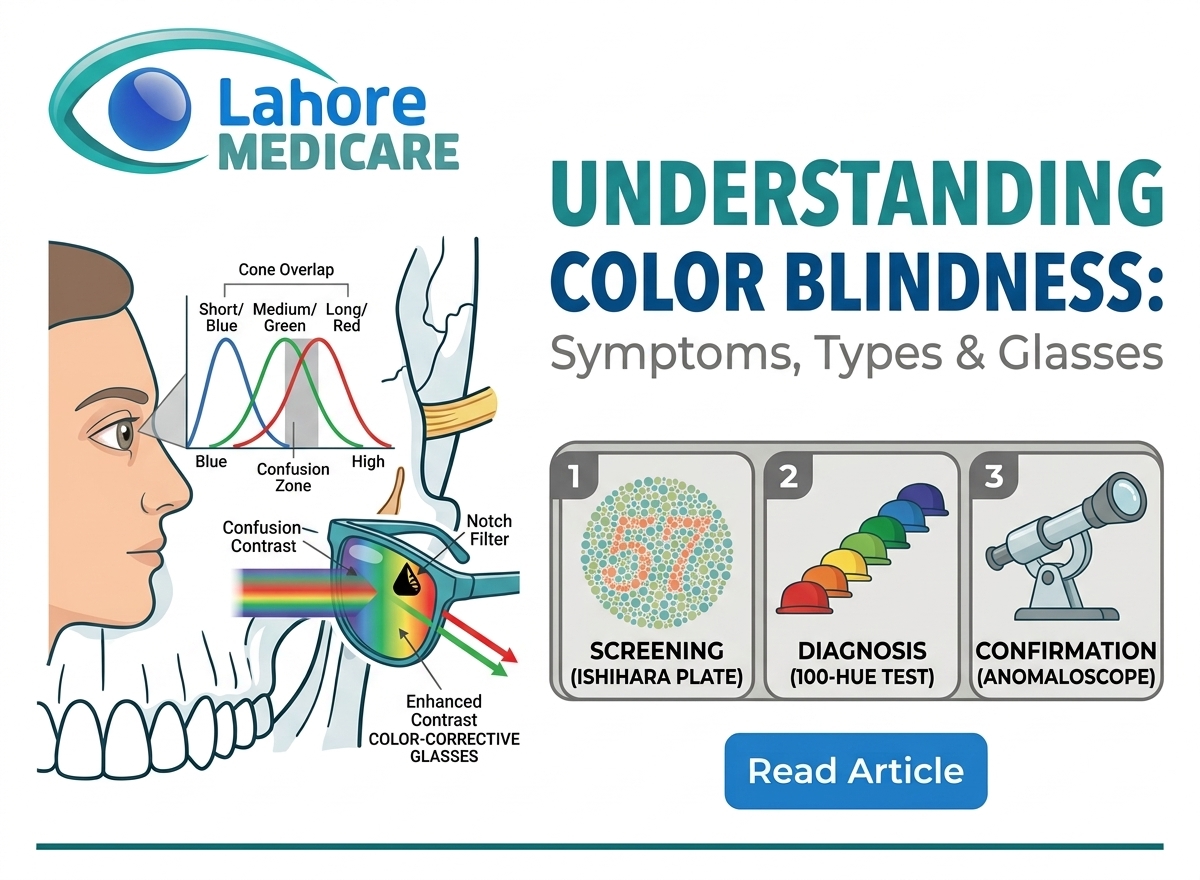
Color vision deficiency commonly referred to as color blindness affects how a person perceives, distinguishes, and processes specific hues. While the term implies seeing the world entirely in grayscale, total color blindness is extremely rare. Most individuals with color vision deficiency can see standard imagery clearly, but they experience subtle or pronounced difficulty separating specific overlapping color spectrums, most frequently reds and greens.
Recognizing early warning signs, understanding the underlying genetic categories, and exploring how optical filtering technology works can help individuals manage color deficiency effectively.
How Do You Know If You Are Color Blind? Key Symptoms
Many adults and children adapt so naturally to their visual environment that they do not realize they process colors differently from others. Color vision deficiency is often identified when comparing perceptions with peers or during early childhood learning.
Key signs and symptoms include:
- Difficulty Distinguishing Specific Color Pairs: Frequent confusion between red and green, blue and yellow, green and brown, or purple and blue.
- Trouble Identifying Brightness and Shades: Inability to tell apart light, dark, or pastel variations of the same color family.
- Challenges in Everyday Tasks: Struggling to identify ripe fruit, read color-coded financial charts, interpret transit maps, or match clothing combinations.
- Pediatric Warning Signs: Parents or teachers may notice a child using unusual colors for everyday objects in drawings (such as coloring tree leaves purple) or struggling with color-sorting exercises.
Clinical Note: Inherited color blindness stays consistent throughout a person’s life without worsening. However, if you experience a sudden change in color perception, consult an eye specialist promptly, as this may indicate underlying health conditions such as cataracts, optic nerve inflammation, or retinal disease.
The Different Types of Color Blindness
Human color perception relies on three types of retinal cone cells tuned to short (blue), medium (green), and long (red) wavelengths of light. Color vision deficiencies are categorized based on which specific cone type is affected or absent:
1. Red-Green Color Blindness
The most common form by far, red-green deficiency is a genetic trait passed down via the X-chromosome. Because males possess one X-chromosome (XY), it affects roughly 8% of men compared to less than 1% of women worldwide.
- Deuteranomaly: The most common form; green cone photopigments are shifted, making greens appear more reddish.
- Protanomaly: Red cone photopigments are altered, making reds appear duller, darker, or more greenish.
- Deuteranopia & Protanopia: Complete absence of functioning green (deuteranopia) or red (protanopia) cone cells.
2. Blue-Yellow Color Blindness (Tritan Deficiency)
Much rarer than red-green deficiency, blue-yellow vision issues affect men and women equally because the gene is carried on a non-sex chromosome.
- Tritanomaly / Tritanopia: Reduced sensitivity or complete absence of blue cone cells, making it difficult to differentiate blue from green, or yellow from violet and pink.
3. Monochromatism (Achromatopsia)
An extremely rare, severe condition where two or all three cone types are completely non-functional. Individuals see only in shades of gray and black, typically accompanied by high sensitivity to bright light (photophobia) and reduced visual acuity.
How Color Blindness Is Diagnosed
Eye specialists use quick, non-invasive standardized visual tests to confirm color vision deficiencies and measure their severity:
- Ishihara Color Plate Test: The most widely recognized screening tool, consisting of circular patterns made of colored dots. Numbers or paths are embedded within the dots that are visible to standard trichromats but hidden or altered for color-deficient viewers.
- Farnsworth-Munsell 100-Hue Test: Patients arrange colored caps in exact chromatic order to measure precise thresholds of color discrimination.
- Anomaloscope: A specialized clinical instrument used to differentiate between partial cone anomalies (anomalous trichromacy) and complete cone absence (dichromacy).
Scheduling a comprehensive examination for common eye diseases and conditions helps rule out secondary retinal issues and gives an accurate baseline of your visual health.
How Color-Blind Glasses Work
There is currently no cure for inherited genetic color blindness, as non-functioning cone genes cannot be replaced. However, specialized color-corrective filter glasses offer an assistive option for individuals with red-green deficiencies.
Optical Mechanism
In anomalous trichromacy (such as deuteranomaly or protanomaly), the sensitivity curves of red and green cone photopigments overlap abnormally, creating a “confusion zone” where the brain cannot distinguish distinct wavelengths.
Color-corrective glasses utilize spectral notch filters that selectively absorb and block specific light wavelengths right in that overlapping zone. By filtering out confusing wavelengths, the lenses increase chromatic contrast between reds and greens, allowing wearers to separate colors more distinctly.
Clinical Reality and Limitations
- Enhancement, Not a Cure: These lenses enhance visual contrast between problematic shades; they do not restore natural 100% color vision or cure cone deficiencies.
- Requires Functional Cones: Color-filtering glasses work primarily for mild-to-moderate anomalous trichromats. They are not effective for individuals with complete cone absence (dichromats or monochromats).
- Varied Results: Clinical responses vary widely among wearers depending on individual eye physiology and daily environment.
If you require specialized visual evaluations or prescription lens consultations, visiting established medical centers like Lahore Medicare provides access to advanced ophthalmic procedures and expert optical guidance.
Frequently Asked Questions
How do I know if I am color blind at home?
You can look for common signs, such as difficulty telling apart reds, greens, browns, or purples, or taking a basic online Ishihara plate screening test. However, a formal diagnosis requires a clinical evaluation by an eye doctor.
Do color-blind glasses cure color blindness?
No. Color-blind glasses do not cure the underlying genetic deficiency. They use optical filters to block overlapping wavelengths of light, enhancing color contrast so wearers can separate red and green shades more clearly.
Why are men far more likely to be color blind than women?
Red-green color blindness is an X-linked recessive genetic trait. Because men have only one X-chromosome (XY), inheriting a single mutated gene results in color blindness, whereas women (XX) must inherit the mutated gene on both X-chromosomes.
Can children be tested for color blindness before they can read numbers?
Yes. Eye doctors use specialized pediatric screening plates that feature simple shapes, objects, or animal outlines instead of numbers.
Is color blindness progressive?
Inherited genetic color blindness is stable and does not worsen over time. Sudden or progressive changes in color perception are usually caused by underlying medical issues such as optic nerve damage, cataracts, or retinal disease.
Do color-blind glasses work for everyone with color deficiency?
No. They work best for people with mild to moderate red-green color deficiency (anomalous trichromacy) who still have three functional cone types. They do not work for people who completely lack one or more cone types.
What is the Ishihara test?
The Ishihara test is a widely used screening tool consisting of pseudoisochromatic plates filled with colored dots that form numbers or paths to detect red-green color deficiencies.
Can you drive if you are color blind?
Yes. In almost all countries, individuals with color vision deficiency can hold a standard driver’s license by learning the positional sequence of traffic signals (red on top, green on bottom) and using light contrast cues.